Survey Scheduler
After prioritizing the LeadingEdge platform, I transitioned to the Survey Scheduler team, which was responsible for connecting incoming leads from LeadingEdge to Sales Representatives’ calendars. This required designing workflows that integrated multiple API connections with third-party vendors, ensuring data accuracy, seamless scheduling, and a frictionless experience for both agents and customers.
-
This application was built out of necessity following the launch of LeadingEdge. Previously, the St. Louis–based call center (CEC) received incoming leads and manually patched calls through to an agency contact. With the automation of lead generation and the introduction of a round-robin assignment model, this approach no longer scaled.
The CEC needed a way to bypass agency gatekeepers and schedule directly on the calendars of the responsible Sales Representatives. Beyond basic scheduling, the application required full lifecycle functionality—including the ability to contact leads, confirm appointments, reschedule when needed, and follow up—ensuring no lead was lost due to process or timing gaps.
-
By centralizing lead generation and assignment on behalf of agencies across the organization, we created a strategic differentiator for the agency family. To fully realize that advantage, the calendar and scheduling experience needed to go further—it had to be intuitive, efficient, and easy to use.
Designing for screen size responsiveness was critical. This user base is constantly on the move, so the scheduler was intentionally optimized for all device usage, enabling sales representatives to view, manage, and update appointments quickly without friction. The result was a scheduling experience that supported real-world workflows while reinforcing trust in the broader lead management ecosystem.
-
With more than 500 sales representatives across the agency family, each brought their own expectations and mental model of what an “ideal” scheduling experience should be. To design a solution that could scale, I conducted extensive user research—tirelessly interviewing representatives from large, small, and mid-sized agencies to surface critical tribal knowledge that had never been formally documented.
It was essential to fully understand how schedules were actually used in the field, as every interaction directly impacted sales and completed moves—the core of the business. I facilitated a mix of 1:1 interviews and group sessions, each yielding detailed insights that required careful synthesis. These findings were prioritized into a phased release strategy that balanced user needs, technical feasibility, and business goals.
In parallel, I clearly communicated research outcomes and proposed approaches to Product partners, key stakeholders, and Board members, securing alignment and buy-in at every level of the organization.
-
The launch was intentionally phased within the existing ecosystem to minimize disruption for both the Customer Experience Center (CEC) and Sales Representatives. To support adoption, we hosted open office hours where agency partners could ask questions, share concerns, and receive hands-on guidance—meeting users where they were as their workflows evolved.
The CEC adopted the new scheduler immediately, recognizing it as a significant improvement over the previous experience. A process that once required three to five steps was streamlined into just two screens, dramatically improving speed and efficiency.
Sales Representatives required more time to adjust, particularly those with over a decade of industry experience. Through a combination of office hours, guided training videos, and ongoing availability alongside Product via email, we gradually built trust and confidence in the new workflow. Over time, this support led to broad adoption and appreciation of the redesigned scheduling experience.
-
After the core design needs were met, I transitioned off the project. The solution continued to perform at scale, delivering measurable impact across the organization. Key outcomes include:
114,131 appointments assigned through the scheduling platform
98.2% successfully routed to Vanline Agents, demonstrating high accuracy and trust in the routing logic
1.8% routed to Cross-Vanline Agents, supporting edge-case flexibility without disrupting core workflows
Less than 1% surplus, indicating minimal over-allocation or system inefficiency
35,864 non-serviceable leads identified, preventing wasted effort and setting clearer expectations earlier in the process
These results validate the effectiveness of the design in handling complex, high-volume workflows while reducing failure points and improving operational confidence for both the Customer Experience Center and Sales Representatives.
-
Team Dynamics:
Team Composition: 1 UX/UI Designer (Lead), 1 Product Owner, 2-4 Developers (Downsized due to effectiveness)
Delivery Model: 2-week sprints with a Kanban approach
Environment: 100% remote
Core Ceremonies:
Standup (3x weekly)
Sprint Planning (weekly)
Refinement (weekly)
Product/UI Sync (weekly)
Retrospective (bi-weekly)
Tools Used:
Jira
Figma
FigJam
AirTable
HubSpot
Project Evolution
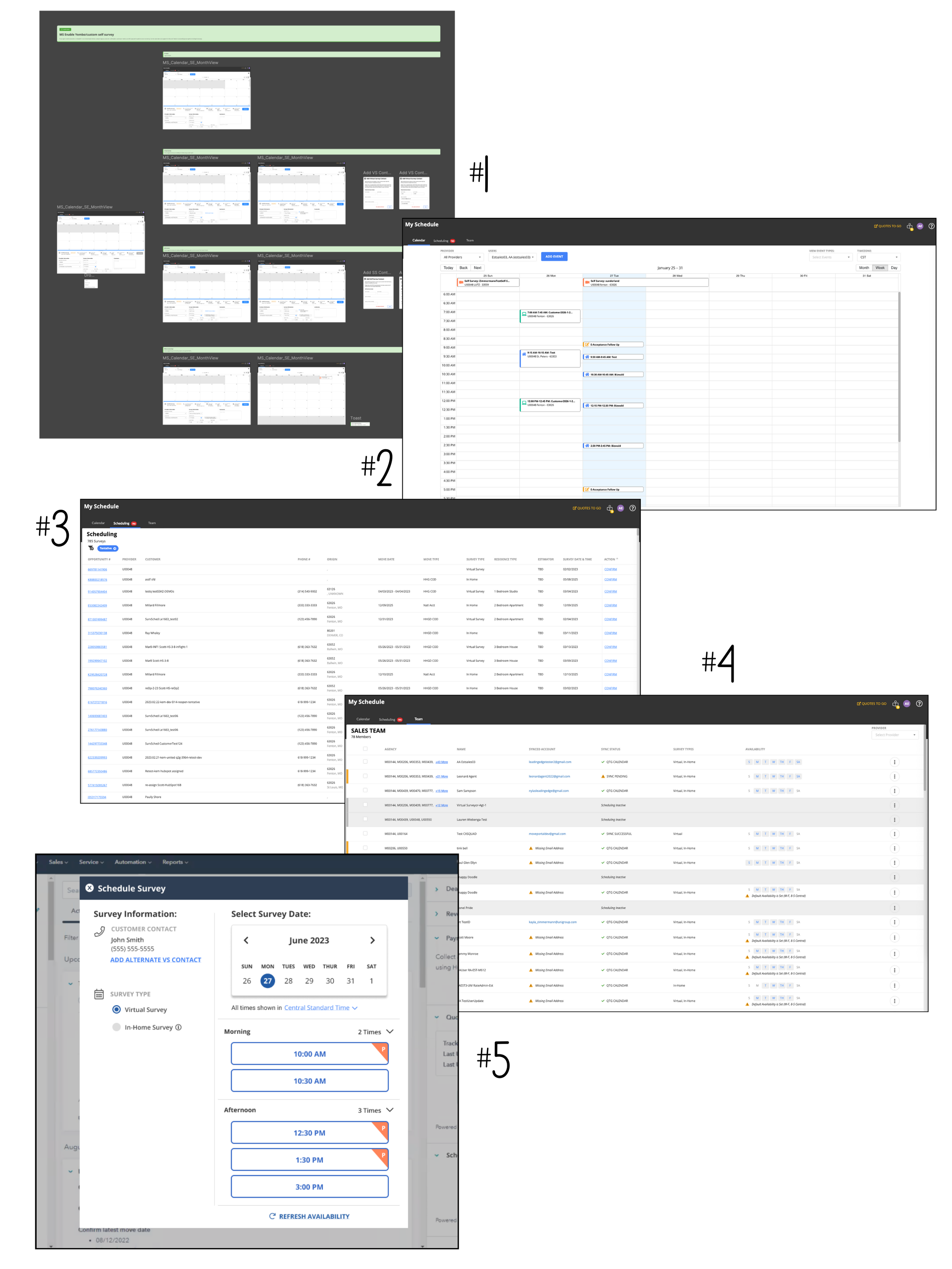
#1: Demonstrates how the Figma file was intentionally structured and organized to account for edge cases and complex scenarios. This setup ensured that uncommon but critical workflows were clearly documented, easy to navigate, and fully considered during design and development—reducing ambiguity and preventing gaps in implementation.
#2: Introduces the redesigned calendar experience, informed directly by user research that revealed how central calendars are to Sales Representatives’ daily work—often described as their “source of truth.” As a result, the design treated the calendar with care and intention, ensuring every element had a clear purpose and avoided unnecessary noise. The experience included both expandable and condensed views, allowing users to choose the level of detail that best supported their workflow and preferences.
#3: Introduced an Opportunity-focused view that allowed Sales Representatives to review and manage their scheduled surveys in a CRM-style format, offering an alternative way to consume and organize their work beyond the calendar. This functionality was intentionally released as a secondary phase, enabling users to first adopt the core scheduling experience before layering in more advanced management capabilities.
#4: The Team tab was designed as a manager-only view, enabling leaders to add new Sales Representatives and adjust existing schedules. Changes made here were reflected in real time within the LeadingEdge system, ensuring the Customer Experience Center received accurate, up-to-date availability when serving schedules. This view supported operational control while maintaining alignment across interconnected systems.
#5: This view represents the Customer Experience Center’s perspective when scheduling a survey. The interface was designed with a clear hierarchy of information, surfacing the most critical details first to support fast, confident decision-making during live calls. This structure reduced cognitive load and enabled the CEC to schedule efficiently while maintaining accuracy.